Marketing for coaches, consultants, and therapists in Facebook groups
In fields where you are the product, no one buys from an ad. People buy from someone they’ve seen enough times to feel understood.
A coach or consultant sells something you can’t see before buying. So people decide based on a sense that "they get it", and that comes only from repeated exposure to your content. Groups are the cheapest place to build that.
Where your audience actually is
The common mistake is looking for groups in your own field. Coaching groups are full of coaches, not clients.
- Groups about the problem, not the solution. A fitness coach needs groups for new mothers or casual runners, not groups for other fitness coaches.
- Freelancers and business owners groups if you are a business consultant. That’s where people ask the questions you answer.
- Local groups if your service is in-person. If it’s on Zoom, location doesn’t matter and competition is nationwide.
- Hobby and interest groups where your audience is for completely different reasons.
- Peer groups for referrals only. A client who isn’t right for you may be right for someone else, and vice versa.
How to build authority without sounding like an ad
Builds authority
- A detailed answer to someone else’s question
- "In this case, I wouldn’t recommend coaching"
- Explaining a mistake you keep seeing
- A client result with numbers and how long it took
Burns authority
- Motivational quotes over a sunset background
- "Only 2 spots left!" every week
- A success story with no real details
- Promises of results in a set time
How to fill a workshop or group
A single sales post almost never fills a workshop. What does work is a four-week sequence, with the offer only at the end:
- Week 1: The problem. Describe the situation your audience is in, without mentioning the workshop. The goal is “that’s exactly me”.
- Week 2: Demonstration. Teach one useful thing from your content. Whoever tries it benefits, and sees there’s more.
- Week 3: Proof. A real case, with one verifiable detail and a timeline.
- Week 4: The offer. Date, price, number of spots, and how to sign up. Now it doesn’t sound like an ad because the audience already knows you.
Three common objections and how your content addresses them in advance
Referrals in this field almost always get stuck on the same three things. You can address them in your content, before the call, so the call starts from a different place.
| The objection | The post that addresses it |
|---|---|
| “It’s too expensive for me” | Explain exactly what’s included, and how much time it saves or creates. Price without context always sounds high. |
| “I don’t have time right now” | An example of someone who started during a busy period, with the real number of hours. |
| “I tried and it didn’t work” | Explain why the previous approach fails, without putting down those who tried. |
How to measure a channel that works slowly
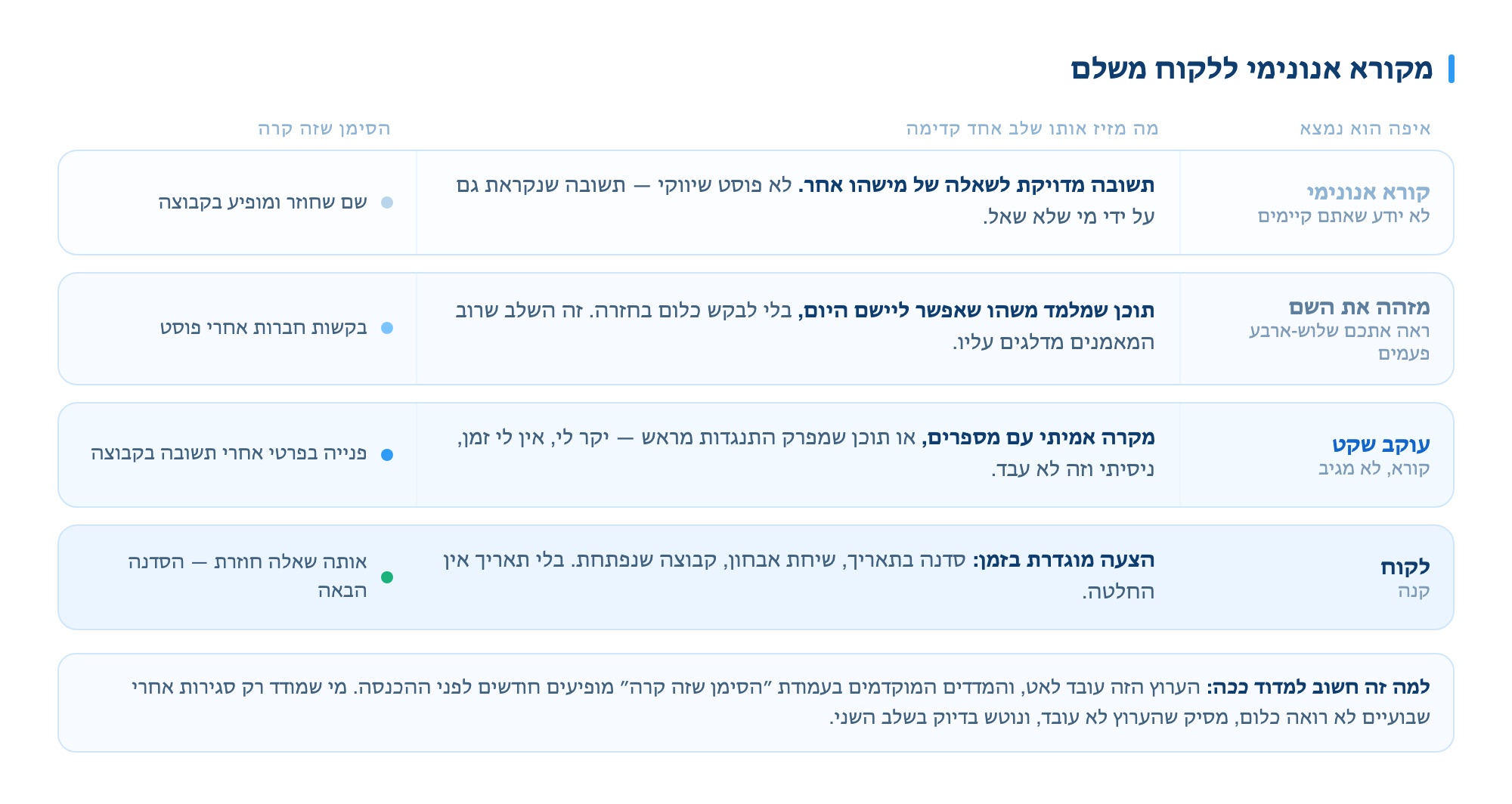
This is where most coaches give up: they check after two weeks, see nothing, and decide the channel doesn’t work. What is worth measuring:
- Private messages after answering in a group. This is the strongest early indicator, and it shows up long before revenue.
- How many people added you as a friend after a post. In this field, it’s a clear sign your audience is warming up.
- Repeated questions on the same topic. If the same question comes up three times, that’s your next workshop.
- Where each closed client came from. After five clients, a clear pattern emerges.
Four mistakes coaches and consultants keep making
- Post in peer groups. Coaches sit in coaches’ groups. Your audience is in groups about the problem, not the profession.
- Generic motivational content. A quote over a sunset doesn’t set you apart. Explaining a specific mistake does.
- Selling in the first post. In a field where people buy you, a sales post before anyone knows you looks like spam.
- Quitting after a month. This channel is built on gradual familiarity. A month is exactly when it starts working.
How to stay consistent when you have clients
This channel depends on consistency, and it’s the first to drop in a busy week. Postly lets you write your monthly sequence in one sitting, pick your group list, and schedule everything in advance, so your presence stays even when you’re busy. More: Scheduling posts to groups.
Want to fill your next workshop?
Leave your details and we’ll show you how one post reaches every group where your audience is, at a pace that doesn’t look like spam.
For a free demo